How Teaching Symfony Helps Improve It

While researching and building our recent Symfony Security: The Basics and Symfony Security: Going Further courses I found a few things that could make the developer experience better, opportunities for clearer explanations and a few things that led to discussions and pull requests.
The process of making a course includes researching a feature, building an example, trying the awkward cases, and explaining every step. A workaround we might accept in our own application deserves another look when we're about to teach it to someone else.
Several improvements from creating those two courses are now a part of Symfony 8.2, let's take a deeper look at those.
Disabling users who are already logged in
Disabling an account sounds straightforward: add an enabled flag and have a
user checker reject disabled users during login.
But what happens if the user is already logged in?
Using EquatableInterface for this meant taking over Symfony's user comparison
logic. Keeping the existing checks for password, role and identifier changes
meant reproducing that logic in the application. That's quite a detour for a
boolean flag.
This led to
CheckRefreshedUserEvent and
the user_checker_on_refresh
option. Symfony can keep its
normal checks and run your configured user checker when it reloads the user from
the session. The official SecurityBundle recipe for Symfony
8.2 now enables this by default,
so new applications that add a checker for disabled accounts will also log those
users out on their next request.
Safer impersonation and simpler buttons
Impersonation is useful when you need to see what another user sees. The
familiar _switch_user query parameter makes it easy to try, but it also means
changing the active user through a GET request.
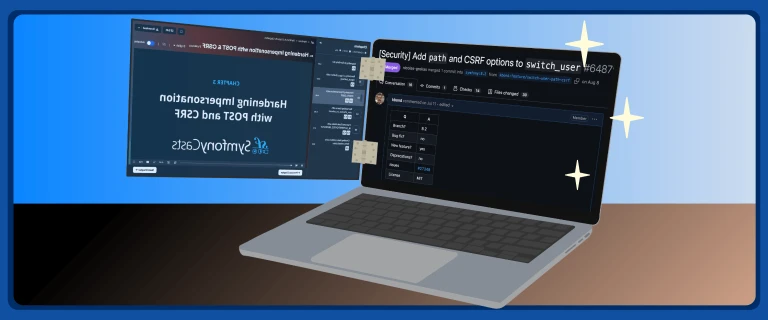
For the course, we wanted a straightforward way to use a dedicated POST endpoint
with CSRF protection. That became the new path and CSRF options for
switch_user.
During review, Nicolas Grekas added impersonation_form() and
impersonation_exit_form().
These provide the form's action URL and hidden fields from the firewall
configuration, including the CSRF token when enabled. The template still renders
the form.
It made sense to do the same for logout, and Nicolas beat me to it by adding
logout_form().
Nicolas then took the idea further with button helpers. They render the complete POST form, including its hidden fields and button, saving us from writing the same Twig markup each time:
{{ logout_button('Log out') }}
{{ impersonation_button('Impersonate', user.userIdentifier) }}
{{ impersonation_exit_button('Exit impersonation') }}
We can customize the labels and HTML attributes.
There were smaller fixes along the way, too, including making the impersonation
helpers respect a configured
target_route when no explicit
destination is supplied.
Connecting sudo mode to the login form
Asking someone to confirm their password before a sensitive action is another feature we cover in the courses.
Nicolas Grekas added the recent-authentication checks and re-authentication
infrastructure for
Symfony 8.2. The next step was making form_login participate in the new
flow.
Symfony can send the user back to the login form and provide their existing username for it to fill in. The login page can also distinguish a password confirmation from an ordinary login, which matters if it normally redirects anyone who's already authenticated.
That last detail is easy to miss until you put the whole flow together.
Giving users useful error messages
The same kind of friction shows up when a rate limit is reached or a signed link has expired. An attribute makes the check convenient, but an HTML application often needs a helpful message and a redirect.
Another contribution lets controllers receive specific failures from
attributes such as
#[RateLimit] and #[IsSignatureValid], so the controller can handle the
problem while keeping the attribute. It removes a reason to go back to
performing the check by hand.
Signed links that stop working when they should
A password-reset link should stop working after the password changes. Versioned signed URLs let a link's validity depend on a value such as the user's password hash. Once that value changes, the old link no longer validates.
A related change added support for a default expiration and deprecated signing URLs without an expiry. These are useful building blocks for links that grant temporary access or perform a specific action.
Configuration that is easier to explain
The stateless CSRF defaults for login and logout were installed by the Form component's recipe. An application using Security without Forms missed those defaults. The configuration now lives in the appropriate recipes, so installing the security components supplies their own defaults.
A misleading remember_me option
Researching remember-me behavior for the courses turned up a setting that
Symfony accepted but no longer used: the remember_me option under form_login
and other authenticators. Changing its value had no effect.
That option is deprecated in Symfony 8.2. It's a small cleanup, but an option that does nothing is confusing whether you're writing a course or configuring your own application.
Creating rate limiters where you need them
The rate limiting research also led to
RateLimiterBuilder. In
Symfony 8.2, a service can inject one builder and create limiter factories as
needed, without a separate configuration entry and injection for every limiter.
That's useful for a limiter needed in just one place, or when its settings are only known at runtime. It lets us configure those limiters directly in the code that uses them.
That work is continuing. Another PR would let us define a rate limiting policy directly on a controller action or its injected limiter argument. With the argument approach, the controller would decide when to consume the limit, which is useful when only failed attempts should count. This one didn't make Symfony 8.2, but we're hoping it lands in 8.3.
The work carries beyond the course
These changes were shaped by discussion and review with other Symfony contributors. Finding the problem is one piece of the open source puzzle; arriving at something that fits the framework takes collaboration.
In Symfony 8.2 Security Upgrades, we return to the same application and replace several of our earlier workarounds with the new tools. We simplify logout, protect impersonation with POST and CSRF, revisit disabled-user sessions, and apply the new recent-authentication checks.
This is a less visible part of our tutorial creation process. The time we spend building examples and questioning awkward steps leads to improvements in the Symfony developer experience. That's part of the hidden value of your SymfonyCasts subscription: helping support the research and collaboration that make improvements like these possible.
And this time, part of the lesson is deleting code, a very satisfying outcome.